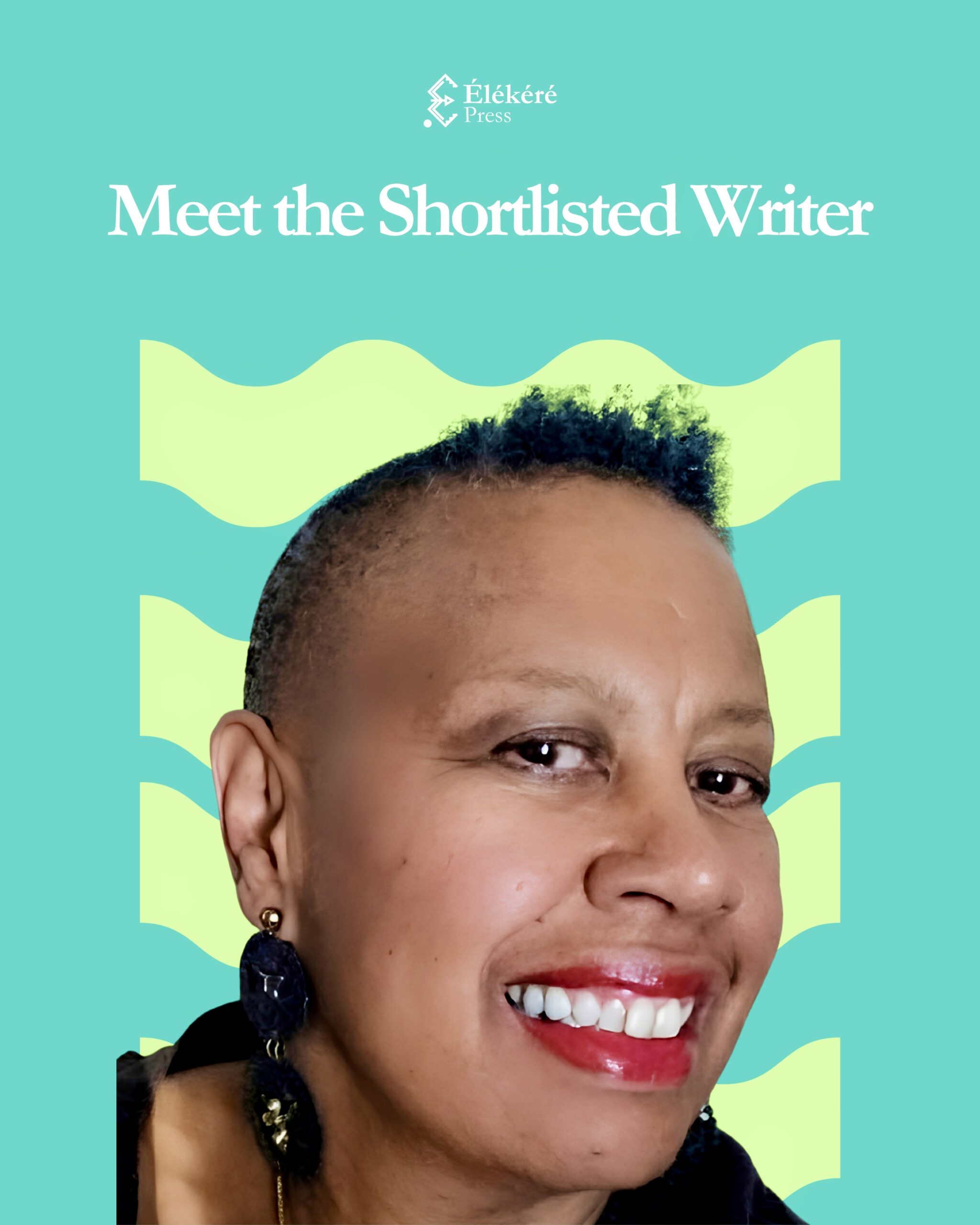

In Shirley Strickland’s fiction, women pursue freedom of body and mind, often defying expectations that seek to contain them. Moving between historical fiction and speculative storytelling, her work explores the complexities of human experience through diverse female characters.
Strickland wrote The Awakening of La Muse, a historical novel set in Paris in 1855. Her short story, Poinciana, the Fisherman and the Pink Seashell, a work of speculative fiction, was recently published by The Caribbean Writer. Her shortlisted story, Portrait of Man, follows a newly widowed middle-aged woman who travels alone to France, where an encounter with a painting draws her into an unexpected obsession.
In this conversation, Strickland reflects on the experiences that led her to writing, the historical and literary works that inspire her, her recently completed novel Orchids of Africa, and what international recognition from the Élékéré Short Story Prize could mean for her writing career.
1. Introduce yourself!
I am the author of The Awakening of La Muse, a historical novel set in Paris in 1855. My short story, Poinciana, the Fisherman and the Pink Seashell, a work of speculative fiction, was recently published by The Caribbean Writer. Female and diverse characters lead the stories I write.
2. How would you describe your authorial interests? What themes, questions, and topics interest you?
I gravitate towards historical fiction and, more recently, speculative storytelling. The themes that attract me centre on women uncovering their freedom of body and mind, regardless of the consequences.
“They took her freedom; she took it back!” is an excerpt from The Awakening of La Muse that captures this interest.
3. Tell us about your shortlisted story and what inspired it.
Portrait of Man delves into the psyche of a middle-aged woman who has recently been widowed and her efforts to assert her independence in the face of family and cultural expectations.
She travels to France alone, where she encounters a painting of a nomad standing alone in the desert. She becomes mesmerised by the image, to the point of obsession.
The inspiration for this narrative came from an image I once saw: a photograph of a man that sparked a fantasy and made me wonder, “What if?”
4. What are some authors and writers you admire, and why?
I admire Edward P. Jones and his novel The Known World, a riveting story set in the antebellum American South that explores the intricate realities of human experience and the struggle for freedom within enslaved societies.
Barbara Chase-Riboud also inspires me through her refined eloquence and meticulous research. In historical novels such as Sally Hemings and Valide, she takes readers on journeys into the past they might never have imagined.
Desert Dawn by Waris Dirie was another great inspiration. Her account of life within a nomadic tribe influenced my writing of Orchids of Africa.
I also admire Chinua Achebe’s Things Fall Apart.
5. When did you first realise you were a writer? What was the moment like?
I spent nearly ten years living abroad, in England and Germany. During that time, I travelled frequently throughout Europe. Exposure to different cultures, art, music and literature transformed me beyond recognition.
When I returned to America, I began writing to keep my journey and experiences alive. Suddenly, I had something to say. What began as journaling gradually turned into storytelling.
6. What is a typical writing day like for you?
My creative energy is at its best in the mornings. On good days, I write from 5 a.m. until 11 a.m. Three hours is all I can muster, though that does not mean I stop thinking about particular scenes and chapters for the rest of the day.
7. What are you working on? Tell us about your works in progress.
I have just completed a historical novel entitled Orchids of Africa, set against the chaotic backdrop of the 1974 Ethiopian Revolution. I am currently looking for a publisher.
8. If you could reread any book or story multiple times, what would it be and why?
I enjoy reading French short stories, particularly those by Guy de Maupassant.
9. What would winning the Élékéré Short Story Prize mean to you?
The international exposure would give my creative writing endeavours exceptional prominence. Perhaps I would also find an international publisher.
10. Where can people reach you or follow you?
Readers can connect with me through the following platforms:
- Website: www.thepenpanther.com
- Email: thepenpanather@gmail.com
- Instagram: @srstrickland
- Facebook: Shirley Strickland