
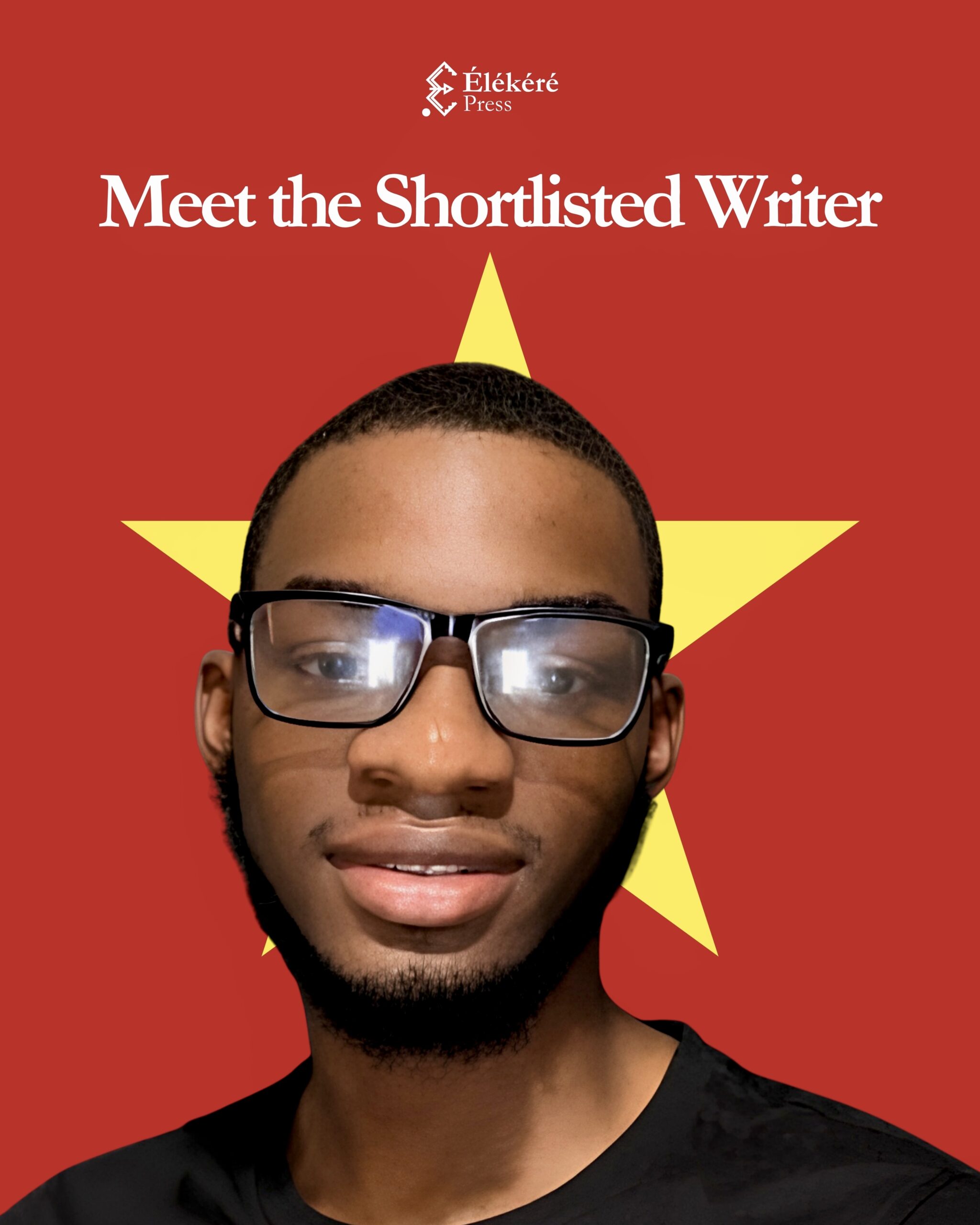

What happens when a person inherits a failure they did not create but must decide whether to take responsibility for it? In Haliru Ali Musa’s fiction, ordinary life often conceals unsettling questions about identity, memory, responsibility, and power.
A Nigerian writer and power engineer based in Lagos, Musa draws on his professional experiences to explore the human stories behind the systems people depend on. His shortlisted story, N/A, Check Next Visit, follows an engineer investigating the death of a tailor whose shop was supplied by a transformer he was responsible for maintaining. As the investigation unfolds, he must decide whether to acknowledge his own failures or hide behind the neglect he inherited.
Musa is the recipient of the inaugural Alexander Nderitu Prize for World Literature and the 8th African Writers Award. In this conversation, he reflects on the real-life experiences behind his shortlisted story, the writers whose work continues to inspire him, his writing routine, and the difficult questions that shape his fiction.
1. Introduce yourself!
My name is Haliru Ali Musa. I am a Nigerian writer and power engineer based in Lagos. I won the inaugural Alexander Nderitu Prize for World Literature and the 8th African Writers Award.
2. How would you describe your authorial interests? What themes, questions, and topics interest you?
My authorial interests lie in finding strangeness inside ordinary life, which is why I read magical realism and surrealism, and why books that carry me into the past draw me.
My themes are identity, memory, belief, and the contradictions of contemporary Nigeria. The question I keep asking is what a person owes for what they inherit, whether a job, a debt, or an accusation.
My topics come from where I stand: the infrastructure we live under, the people who maintain it, and grief.
My shortlisted story is realist because it comes from my working life, and it carries the same interest, since a transformer on a pole is ordinary until someone dies beneath it.
3. Tell us about your shortlisted story and what inspired it.
N/A, Check Next Visit comes from my own work. I am the engineer responsible for these transformers, and a woman died in a shop one of them fed.
In the story, a tailor dies while ironing in her shop, and the community blames the transformer supplying it. That unit went eleven months without inspection before the engineer took charge, and another five months passed under his watch. When a company panel investigates, he must decide whether to admit his own failure or hide behind the neglect he inherited.
I wanted to show how easily a person’s life can disappear behind a maintenance record. I couldn’t leave out the tailor’s exercise book, where she recorded her savings toward a better shop. No incident report had a column for the life she was building.
4. What authors or writers do you admire, and why?
Haruki Murakami and Elif Shafak.
Murakami writes ordinary people in kitchens and offices who slide into strange worlds without announcement. I admire the calmness with which he does this.
Shafak’s research gives her fiction depth without taking away its entertainment value.
5. When did you first realise you were a writer? What was the moment like?
My earliest memory of writing is from junior secondary school. I used to tell stories aloud to a classmate, and one day I wrote one down for him. It was about a group of people setting out to find a lost treasure.
Whether that made me a writer, I am still working out. What I know is that I have kept writing, even when I have wondered whether I could make a living from it.
6. What is a typical writing day like for you?
I mostly draft on weekdays, at night and in the early morning, around my work hours.
Drafting is self-depleting. My emotions slip from my hands into the pages, and afterwards I am free to go about the day, sleeping or eating.
Weekends, when I am home with my laptop, are for editing.
7. What are you working on? Tell us about your works in progress.
I am writing Try Salt, a novel about a man whose wife vanishes after he accuses her of an affair. I am also editing a friend’s novel.
8. If you could reread any book or story multiple times, which would it be and why?
1Q84 by Haruki Murakami and The Forty Rules of Love by Elif Shafak.
In 1Q84, I return to the two moons: the quiet moment a character looks up and finds the world has changed, with no announcement.
In The Forty Rules of Love, I return to the story within the story: a modern woman reads a manuscript about Rumi and Shams and slowly discovers that it is also about her.
Every time I finish them, I want to write at their level.
9. Do you have any reading recommendations for us?
Read Chinua Achebe’s Things Fall Apart again. Don’t ask me why, just read it. Achebe never raises his voice, and every sentence still lands.
10. What would winning the Élékéré Short Story Prize mean to you?
Winning this prize would mean a great deal to me, especially after being shortlisted for another prize recently and not winning.
More than anything, it would mean that the judges and readers had recognised something true in a story about looking after 751 transformers.
11. Where can people reach you or follow you?
You can reach me by email at musaalihaliru@gmail.com, or find me on X (Twitter) at @HaliruAliMusa.