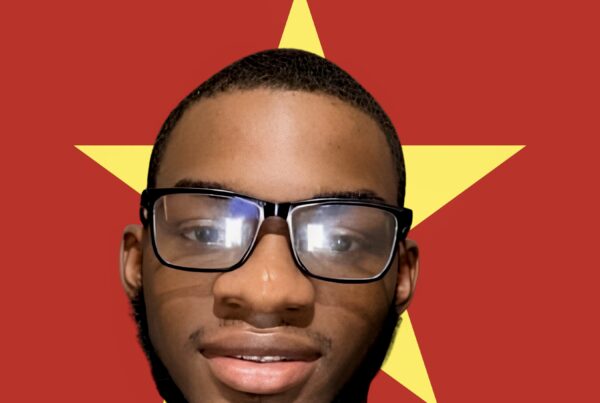


Timothy Ugorji, who also goes by Ezimadu, is a Nigerian writer and a graduate of Mechanical Engineering from Nnamdi Azikiwe University. Drawn to tragedy, African identity, and the everyday lives of Nigerians, he hopes to write stories that examine the people and circumstances that shape the Nigerian experience. His shortlisted story, Tomato Baby, centres on a market woman and the lives of the generations connected to her.
In this interview, Ugorji discusses his love of tragedy, the writers who have shaped his imagination, the experience that first made him want to write, and his ambition to capture the Nigerian condition through fiction.
1. Tell us about yourself.
Hello! I’m Timothy. You could call me Ezimadu—that’s Igbo for “good person”. I wish I were. My grandmother gave me that name. I graduated last year from Nnamdi Azikiwe University, where I studied Mechanical Engineering.
2. How would you describe your authorial interests? What themes, questions, and topics interest you?
First of all, tragedies captivate me. I love the complicity of the good guys in making the bad guy who he is—or creating the tragic situation in general.
My favourite book—I’ve not read many—is A Tale of Two Cities by Charles Dickens. I still remember my excitement when I narrated it to my high school sweetheart. That point where Dr. Manette’s letter resurfaces after decades and is used as evidence to condemn his son-in-law to the guillotine! One of my greatest thrills is that my dearly beloved Christopher Nolan adapted that plot into The Dark Knight Rises.
Then I love Nigeria—Africa, in fact. I love stories that amplify and investigate our identity, fears, anger, grief, and politics. I loved Cry, the Beloved Country, Things Fall Apart, and Half of a Yellow Sun—those sorts of stories that make you cry, make you angry, and make you want to change the world. Our African world.
3. Tell us about your shortlisted story, Tomato Baby, and what inspired it.
That’s a very good question. Wow.
As background, I was reading John Truby’s The Anatomy of Story, and his first point was to write something that might change your life. After reflecting, I decided that my great aim was to write the quintessential Nigerian tragedy—whatever that means. I expect it should approximate what people mean when they say “Nigeria happened” to someone.
I decided that each short story would be me painting another motif onto the canvas: the novel I hoped to write, one that would depict Nigeria in all its gore. In fact, I realised I had already started doing this subconsciously in my last published story, Ballad for the Beloved Conductor, on Efiko Magazine. Shout-out to Ladi Opaluwa, who is a beautiful, magical editor, by the way!
That story is about a bus conductor—one inalienable Nigerian motif—and how he becomes one. From there, everything cascades.
Tomato Baby dances around a market woman, another Nigerian motif. I initially called it Tomato Woman, but one of my friends, whom I sent it to, suggested Tomato Baby. That’s because, in the spirit of inheritance, the story transcends the woman herself and affects the life of her child, even her mother. Really, it touches on the lives of three generations of women.
I didn’t even know what I was going to write. But I knew I wanted the tomato woman on the streets, in the market, along the road, to be seen. Like I said, I just want to amplify the Nigerian condition and foreground the everyday characters who are relegated to being mere parts and components in our rusty Naija machine.
The story is partly a speculation about how she became a tomato seller and what the life of a tomato seller could possibly turn out to be. But, of course, I like tragedies, and if you’ve read Ballad for the Beloved Conductor, you probably know it’s not going to turn out well. God, I need therapy!
4. Which writers do you admire, and why?
Thank you for asking. I can’t really point out the technical reasons why I like them, but I know I’m in awe of their creativity, fluency, grammatical liberty, the musicality of their prose, and the potency of their stories.
I love Idza Luhumyo’s Five Years Next Sunday. It won the Caine Prize years ago. (Yep! My dirty little secret is that a story about a woman’s long hair made me cry.)
I love Laughter Beneath the Bridge by Ben Okri. It’s among the top ten best short stories I’ve ever read. He’s a great writer, by the way. Probably my favourite Nigerian writer.
And yes! Charlie Muhumuza’s Luminous Air of Heaven, published on Lolwe. I think it’s the first short story I ever read. He’s a great writer. Chukwuebuka Ibeh’s Ache of Longing is mad too.
I love Victor Hugo. I’ve read up to Book Four of Les Misérables. I revere Dostoevsky. Charles Dickens has to be my favourite writer—certainly the one I’ve read the most. And Toni Morrison, I worship her. Leonard Cohen as well—more for his music, actually, but he wrote A Ballet of Lepers, so he counts.
5. When did you realise you wanted to be a writer?
That’s a hard one. I’m still sceptical about whether I’ve realised I’m a writer. But I do remember vividly the day I decided I wanted to be one. I’m 22 now, and I’m pretty sure this happened before I was seven.
My mum is Nigerian as they come: conservative, plain, every sparkle of individuality stifled by ageing in Nigeria. But one day, somehow, she was talking to me about death—perhaps some relative had passed away—and she began quoting Julius Caesar out of the blue:
Cowards die many times before their deaths;
The valiant never taste of death but once.
Of all the wonders that I yet have heard,
It seems to me most strange that men should fear,
Seeing that death, a necessary end,
Will come when it will come.
It was so spontaneous that it seemed she had been seized by the Muses. She had become an oracle. She spoke with such vibrance, energy, colour, and life that I decided there and then that I wanted to know and recreate that feeling in everyone I could.
To this day, I know that verse by heart.
6. What does a typical writing day look like for you?
There’s no typical writing day for me. Sorry, I’m no fun.
7. Are you working on anything else at the moment?
I’m still learning to write, and I’m still obsessed with my Nigerian motifs. I’m thinking of publishing a short story collection of five or seven stories, each about a Nigerian character.
I don’t know the full cast yet, but I’m sure I’d like to explore a policeman, a politician, and a pastor. A prostitute, I guess, even though Tomato Baby touches on that lightly. And a Yahoo boy, maybe.
I’ll probably call it A Nigerian Parade or something fun that Queeneth would like.
8. What book would you recommend to readers, and why?
Every book and story I mentioned earlier, because they make me feel something.
9. Is there a book you would love to reread?
Toni Morrison’s The Bluest Eye—Odogwu loved it so much that he made a video about it.
Every story on The Shallow Tales.
A Tale of Two Cities.
I’m planning to read Beloved or The Brothers Karamazov as my next hard-copy read as soon as I can afford to. So those too.
10. What would winning the Élékéré Prize mean to you?
It would mean a lot. Validation, for one. I know I should be proper and not seek external validation, as every self-help book I’ve ever read has told me. But the heart wants what it wants, right?
It would probably mean leaving my parents’ house. God help me if I have to hear another sermon about how writing is not a serious thing for a Nigerian to be doing. I’m pretty sure this isn’t supposed to be here. Like I said, I need therapy.
And most of all, it would be an honour. I’ve read the profiles of some of the other candidates, and boy, am I humbled to be among them.
11. Where can readers find you and your work?
You can find me on:
- Substack: @ezimadu
- LinkedIn: Timothy Ugorji
- Instagram: @ezimadu_ugorji
Thank you indeed. Especially for the questions about Tomato Baby and when I realised I wanted to be a writer. Writing this has reminded me of who I wanted to be. A writer. That is who I am.
Cheers!